25+ Small Japanese Rock Gardens brilliant Ideas

You’re drawn to the serene simplicity of Japanese rock gardens but feel intimidated by their apparent complexity. These contemplative spaces seem to require expert understanding of Buddhist philosophy, years of training in rock placement, and access to rare stones that somehow convey deep spiritual meaning. Every photograph shows pristine examples at famous temples with perfectly raked gravel and impossibly balanced compositions.
This intimidation intensifies when you attempt planning. Which rocks go where? How many do you need? What do the patterns mean? The fear of creating something inauthentic or accidentally disrespecting a sacred tradition paralyzes your efforts. Meanwhile, your small backyard, narrow side yard, or even balcony sits empty when it could provide the peaceful retreat you desperately need in your hectic modern life.
The truth is liberating: small Japanese rock gardens work beautifully in compact spaces through the same minimalist principles that define the art form. These karesansui (dry landscape) gardens actually originated in confined temple courtyards, not sprawling estates. Size matters far less than understanding core design principles asymmetry, symbolism, and restraint. This guide reveals practical techniques for creating authentic Zen rock gardens in spaces from 25 square feet to several hundred, demystifying the process while respecting centuries-old Japanese traditions that transform simple stones and gravel into profound meditative landscapes.
What Is a Japanese Rock Garden?
Japanese rock gardens (karesansui), especially small Japanese rock gardens, represent landscapes using rocks, gravel, and minimal plantings rather than water and lush vegetation. In small Japanese rock gardens, understanding their purpose and history is essential to creating an authentic Zen design that feels intentional rather than decorative.
Karesansui translates as “dry mountain water,” a concept perfectly suited to small Japanese rock gardens where raked gravel or sand represents oceans, rivers, or lakes. Rocks symbolize mountains, islands, or animals, allowing small Japanese rock gardens to express vast natural scenes within compact spaces. These gardens originated in Zen Buddhist temples during the Muromachi period (1336–1573) as places for meditation and contemplation. Monks raked patterns daily as a moving meditation, a practice that continues to inspire modern small Japanese rock gardens. The famous Ryoan-ji Temple in Kyoto, with only 15 rocks in white gravel, demonstrates how small Japanese rock gardens can achieve profound impact through simplicity.
Symbolism defines every element in small Japanese rock gardens. Gravel represents water, with raked patterns suggesting ripples, waves, or flowing streams. Rocks embody natural forces: vertical stones suggest mountains or strength, horizontal stones convey stability or water, and curved stones express flexibility. Many small Japanese rock gardens reference Horai, the mythical islands of immortality, or reduce entire landscapes to their most essential forms. Negative space (ma) is equally important in small Japanese rock gardens, giving the eye and mind room to rest and creating balance through intentional emptiness.
The meditative purpose of small Japanese rock gardens sets them apart from decorative landscaping. These gardens exist for contemplation rather than entertainment. Observing small Japanese rock gardens encourages mindfulness watching light shift, shadows move, and raked patterns evolve over time. This philosophical foundation explains why authentic small Japanese rock gardens feel deeply calming and meaningful, unlike generic gravel gardens with random rock placement.
Essential Elements of Karesansui Design
Small Japanese rock gardens rely on specific components working harmoniously to create balance and meaning in limited areas. Understanding each element’s role is especially important when designing small Japanese rock gardens, where every detail must contribute to an authentic and uncluttered Zen aesthetic.
Gravel or sand forms the canvas of small Japanese rock gardens. Traditional designs use white or light gray Shirakawa-suna (white river sand from Kyoto) or crushed granite. In modern small Japanese rock gardens, Western substitutes like pea gravel (3/8 inch), decomposed granite, or crushed limestone in white, light gray, or tan tones work well. The material should be angular enough to hold raked patterns without rolling smooth like beach sand. Light colors help small Japanese rock gardens feel brighter, clearly represent water symbolism, and highlight raking patterns. A 10×10 foot area in small Japanese rock gardens typically requires about 1.5–2 cubic yards of material at a 2–3 inch depth.
Rocks (ishi) are the bones and soul of small Japanese rock gardens. Japanese masters devote decades to stone selection, considering shape, texture, color, weathering, and spiritual presence (kokoro). For authentic small Japanese rock gardens, choose weathered stones rather than freshly quarried rock, and select pieces in person when possible. Look for stones shaped by natural erosion, varied surfaces with patina or lichen, and forms that feel expressive. Small Japanese rock gardens usually include stones ranging from 6–12 inch accents to larger focal rocks measuring 2–4 feet. Most designs use 3–15 stones total, always arranged in odd numbers to maintain visual harmony.
Moss (koke) often provides the only plant life in small Japanese rock gardens. It softens stone edges, conveys age, and introduces life without overpowering the minimalist design. Hypnum and Polytrichum species suit many small Japanese rock gardens, thriving in shaded, consistently moist conditions with acidic soil (pH 5.0–6.0). Evergreen plants may appear sparingly in small Japanese rock gardens a single sculpted Japanese black pine, pruned azalea, or controlled bamboo grouping adds greenery without disrupting simplicity. Enclosure elements such as walls, fences, or hedges help small Japanese rock gardens feel secluded and contemplative, separating them from visual noise. Together, these elements allow small Japanese rock gardens to feel complete, balanced, and deeply calming despite their restrained design.
Rock Selection and Placement Principles
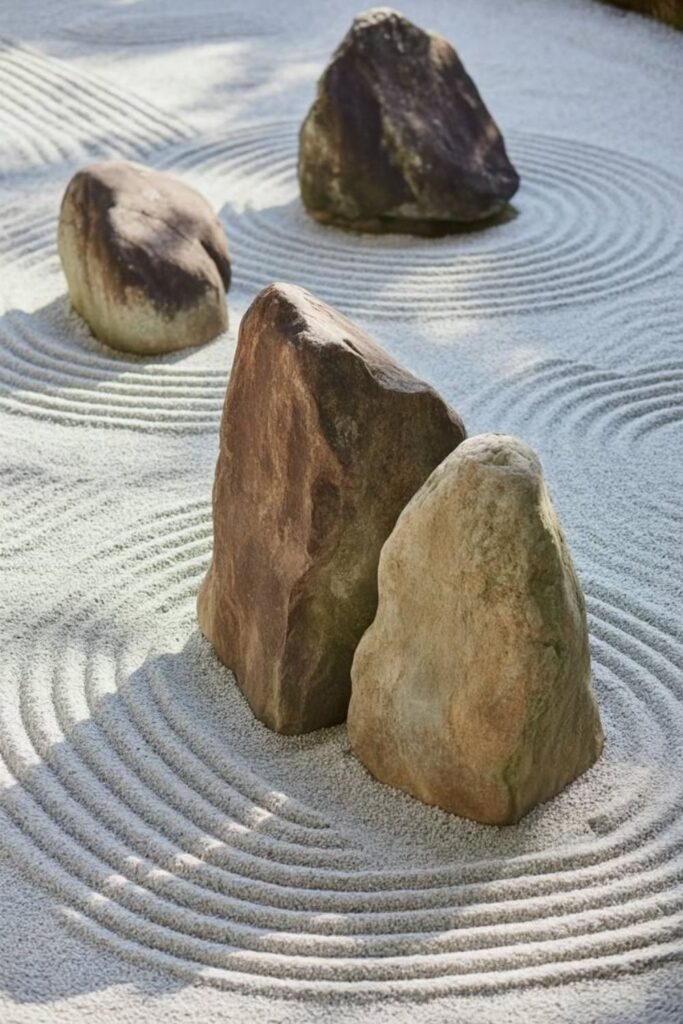
Ishigumi (stone arrangement) is the most critical skill when designing small Japanese rock gardens, as stone placement defines both visual harmony and spiritual resonance. In small Japanese rock gardens, these principles help create balance, depth, and meaning even within limited space.
Odd-numbered groupings are fundamental to small Japanese rock gardens, creating natural asymmetry that feels organic rather than rigid. Stones are arranged in sets of three, five, seven, or nine never even numbers, which appear artificial in small Japanese rock gardens. The most common three-stone composition features a tall vertical “parent” stone symbolizing heaven or mountains, a horizontal “child” stone representing water or earth, and an angled “guardian” stone that provides stability. This triangular structure is ideal for small Japanese rock gardens because it offers visual interest from multiple angles. Partial burial is equally important; in authentic small Japanese rock gardens, 30–50% of each stone is buried, with larger stones set deeper. This ne-ishi (root stone) technique makes rocks appear naturally emerging from the earth rather than placed on the surface.
Viewing angles strongly influence success in small Japanese rock gardens. Stones should feel balanced from primary viewpoints such as benches, pathways, or windows overlooking the garden. When arranging stones in small Japanese rock gardens, walk around the composition, adjusting placement until it feels harmonious from all sides while still maintaining visual intrigue. The sanzon (three-deity) layout, commonly used in small Japanese rock gardens, positions the tallest stone slightly off-center, flanked asymmetrically by supporting stones. Weathering and texture are just as important as shape; moss-covered or naturally worn stones enhance the sense of age and authenticity essential to small Japanese rock gardens.
Traditional stone types used in small Japanese rock gardens include tateishi (vertical stones), taiji-ishi (flat, horizontal stones), kutsunugi-ishi (stepping stones), and shima-ishi (island stones rising from gravel “water”). Color harmony is crucial in small Japanese rock gardens, with stones selected from similar tonal families rather than sharply contrasting hues. Spacing also matters; stones should feel connected but not crowded. A general guideline for small Japanese rock gardens is spacing stones 1.5–3 times their height apart, though intuition and artistic judgment ultimately guide final placement. With patience and practice, these timeless ishigumi principles allow even beginners to create serene, well-balanced small Japanese rock gardens.
Read More About: Best Small Corner Garden Ideas for Beautiful Spaces
Gravel Types and Raking Patterns
Gravel selection and pattern creation are essential to small Japanese rock gardens, transforming simple materials into symbolic representations of water and natural forces. In small Japanese rock gardens, these techniques balance practical needs with aesthetic intent, ensuring the space feels calm, intentional, and authentic.
Material choices for small Japanese rock gardens depend on climate, budget, and desired visual effect. Pea gravel (3/8–1/2 inch) is a popular option for small Japanese rock gardens because it holds raked patterns well while remaining affordable ($30–50 per cubic yard). Angular gravel interlocks better than rounded stones, making it ideal for small Japanese rock gardens. Decomposed granite offers a finer texture with earthy tones and compacts firmly, which works well in high-traffic small Japanese rock gardens.
Crushed limestone or granite in white or light gray most closely resembles traditional Japanese materials. Avoid overly fine materials that blow away or coarse stones that won’t hold patterns both disrupt the clean look of small Japanese rock gardens. For proper depth, plan on 1.5–2 cubic yards per 100 square feet at 2–3 inches, and always install landscape fabric beneath small Japanese rock gardens to prevent weeds while maintaining drainage.
Raking patterns define the visual language of small Japanese rock gardens, each representing a different water condition. Straight, parallel lines suggest calm water or gentle currents and are ideal for minimalist small Japanese rock gardens. Begin at one edge and pull the rake backward in steady lines, spacing furrows about 2 inches apart. Concentric circles around stones represent ripples spreading from islands or raindrops, a classic feature in small Japanese rock gardens. Start at the base of each stone and rake outward in smooth, circular motions. Flowing S-curves suggest rivers or streams, while repeating arcs create wave patterns that evoke ocean swells, both commonly used to add movement to small Japanese rock gardens.
Tools and technique matter greatly in small Japanese rock gardens. Traditional wooden rakes with wide tines spaced 2–3 inches apart are ideal, though adapted Western landscape rakes also work. Rake with slow, deliberate movements, walking backward to avoid disturbing completed areas of small Japanese rock gardens. Maintenance frequency varies daily in temple settings, weekly in private small Japanese rock gardens, or after storms disrupt patterns. The act of raking itself becomes a meditative practice (samu), reinforcing the spiritual purpose of small Japanese rock gardens. Through these gravel and raking techniques, small Japanese rock gardens remain dynamic, reflective spaces that change subtly with light, weather, and mindful care.
Small Japanese Rock Garden Layouts

Compact karesansui designs adapt traditional principles to spaces from balconies to small backyards. These layouts maximize impact in minimal square footage.
Courtyard rock gardens (4×6 to 10×10 feet) utilize narrow side yards or enclosed patios. Create an L-shaped or rectangular gravel bed against two walls, installing simple bamboo fencing for enclosure. Place three rocks asymmetrically the largest at one corner third-point, with smaller stones creating triangular composition. Add a single sculpted mugo pine or juniper in one corner. Rake straight lines parallel to the longest wall, with circular patterns around rocks. This minimal design requires just one cubic yard of gravel and 3-5 stones while delivering authentic karesansui aesthetics.
Balcony Zen gardens (3×5 to 5×8 feet) bring contemplative spaces to apartments. Build a low wooden frame (4-6 inches high) to contain gravel, lined with landscape fabric. Use lightweight expanded shale or pumice instead of heavy gravel if weight concerns exist. Place 2-3 smaller rocks (8-12 inches) in asymmetric arrangement. Add a miniature bonsai or potted Japanese black pine. Include a small stone lantern (18-24 inches tall) as a focal point. These portable rock gardens create meditative retreats in the smallest urban spaces.
Corner rock gardens transform unused angles into focal points. Fill a 3×3 or 4×4 foot corner with light-colored gravel. Position rocks in triangular arrangement with the largest stone at the back corner point. Install bamboo screening on both walls for enclosure. Add a tsukubai (stone water basin) with bamboo spout for authentic detail. Strip rock gardens (2-3 feet wide, 8-15 feet long) work along fence lines or building foundations. Arrange rocks in multiple small groupings rather than one large cluster, creating rhythm along the length. These small-scale layouts prove that authentic Japanese rock gardens succeed through restraint and proper proportion regardless of actual dimensions.
Adding Minimal Plantings to Rock Gardens
Plant selection in karesansui gardens emphasizes restraint and purpose. Every plant must earn its place through symbolic meaning, structural contribution, or seasonal interest.
Evergreen trees provide year-round structure without overwhelming compositions. Japanese black pine (Pinus thunbergii) represents longevity and resilience, developing sculptural character through age and pruning. Cloud-prune branches to create rounded foliage pads separated by visible bark. Mugo pine (Pinus mugo) stays smaller (3-6 feet), perfect for compact gardens. Prune annually to maintain density and shape. Juniper varieties like ‘Shimpaku’ offer fine-textured foliage that shapes beautifully. These conifers represent mountains and provide vertical counterpoint to horizontal gravel.
Pruned shrubs add controlled color and form. Azaleas (Rhododendron) provide brief spring blooms before returning to tidy evergreen mounds. Cloud-prune them into rounded organic shapes rather than allowing natural sprawl. Japanese holly (Ilex crenata) mimics boxwood appearance with better cold hardiness, shaping into precise forms. Bamboo creates natural screening while introducing movement and sound. Choose clumping varieties like Fargesia robusta that don’t spread invasively. Plant them at garden edges rather than within primary viewing areas.
Moss gardens within rock gardens create soft green carpets contrasting with hard stone surfaces. Establish moss in shaded areas by removing competing vegetation, adjusting soil pH to 5.0-6.0, and keeping the area consistently moist during establishment. Grasses like mondo grass (Ophiopogon) or Japanese forest grass (Hakonechloa) provide movement with minimal maintenance. Plant them sparingly a single specimen or small cluster rather than masses. Zero plants work perfectly in authentic karesansui where rocks and gravel alone create complete compositions. These minimal planting strategies honor traditional restraint while allowing personal expression through carefully chosen species.
Creating Focal Points and Viewing Areas
Focal points draw attention and create purpose within Japanese rock gardens, while viewing areas provide positions for contemplation. Both elements enhance the meditative experience.
Stone lanterns (ishidoro) serve as classic focal points carrying centuries of tradition. Yukimi-gata (snow-viewing lanterns) feature wide umbrella-shaped caps and short pedestals (2-3 feet tall), traditionally placed near water though they work beautifully in dry gardens. Tachi-gata (pedestal lanterns) stand taller (4-6 feet), positioned along pathways or at garden edges. Modern versions accommodate LED candles or solar lights. Position lanterns where they create visual interest without dominating typically off-center following asymmetry principles. Surround bases with moss or small accent stones.
Water basins (tsukubai) originally served tea ceremony purification but now function as contemplative focal points. Traditional designs feature low stone basins (12-18 inches high) where bamboo spouts drip water, surrounded by river rocks. Modern recirculating systems hide pumps in underground reservoirs. Position basins near viewing areas where visitors hear gentle water sounds. Buddha statues appear rarely in traditional karesansui (more common in temple gardens generally) but work when placed respectfully elevated on stones, positioned thoughtfully, and treated as spiritual elements rather than decoration.
Viewing benches provide designated positions for contemplation. Simple wooden benches (12-15 inches high, no backs) position viewers at optimal angles to appreciate stone arrangements and gravel patterns. Place benches 6-10 feet from primary focal points close enough for detail, distant enough for context. Viewing platforms (tsukimi-dai) create slightly elevated positions (18-24 inches high) offering different perspectives. Build simple 4×4 or 4×6 foot decks using weather-resistant wood. Stepping stone paths guide movement through larger gardens while preventing gravel disturbance. Space stones 14-16 inches center to center, following curved rather than straight routes. These viewing elements transform gardens from static displays into interactive contemplative experiences.
Maintaining Your Japanese Rock Garden
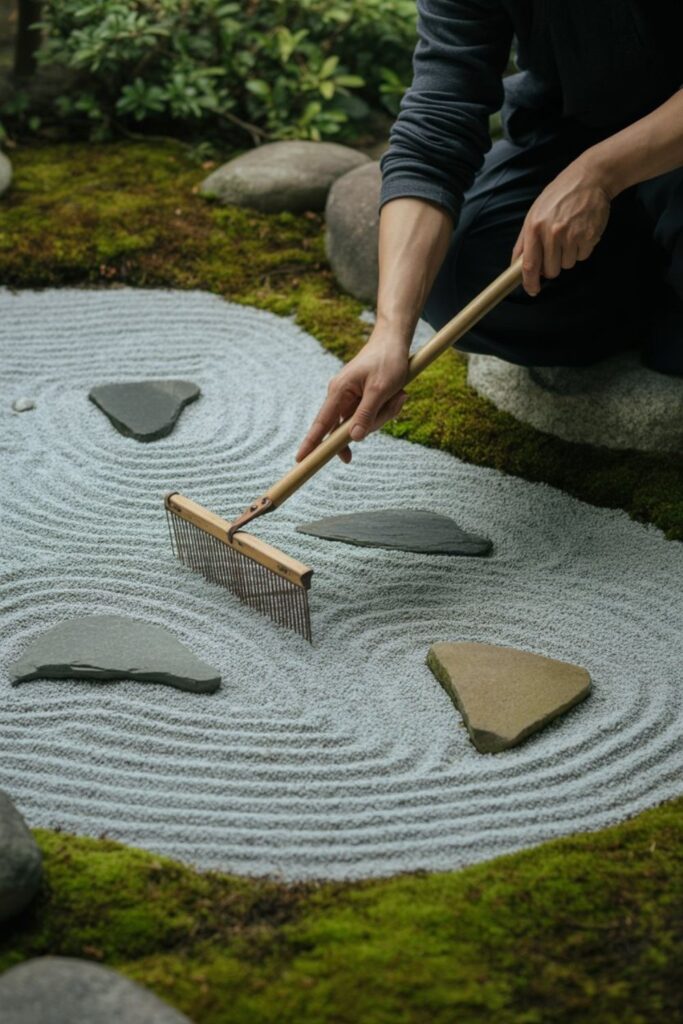
Maintenance practices are essential for preserving the calm beauty of small Japanese rock gardens, while also serving as meditative rituals that align with Zen philosophy. With regular care, small Japanese rock gardens remain pristine without requiring excessive time or effort.
Raking patterns demand the most frequent attention in small Japanese rock gardens. Re-rake after storms, heavy foot traffic, or weekly as a form of moving meditation. Early morning is ideal for tending small Japanese rock gardens, when the air is still and distractions are minimal. Work backward to avoid stepping on finished patterns, pulling the rake smoothly through the gravel with even pressure and consistent spacing. Most small Japanese rock gardens require only 10–30 minutes per session, depending on size. Weed control is also crucial in small Japanese rock gardens. Remove weeds as soon as they appear, before roots become established. While landscape fabric beneath gravel reduces weed growth in small Japanese rock gardens, weekly checks are still necessary.
Moss care adds life and softness to small Japanese rock gardens. During dry periods, mist moss regularly, especially in hot climates where small Japanese rock gardens can dry out quickly. Moss thrives in shaded areas with steady moisture. Remove fallen leaves immediately, as they can smother moss in small Japanese rock gardens within days. Stone cleaning helps small Japanese rock gardens maintain their natural, weathered appearance. Use soft brushes and water to remove dirt, avoiding pressure washers that strip away patina. Clean stones annually or when buildup becomes noticeable. Pruning maintains intentional plant forms in small Japanese rock gardens; cloud-prune pines and azaleas yearly and remove dead bamboo culms at ground level.
Gravel refreshing is needed in small Japanese rock gardens every 3–5 years as materials compact, weather, or are displaced. Add fresh gravel to restore the 2–3 inch depth, lightly blending it with existing material. Seasonal adjustments keep small Japanese rock gardens visually engaging throughout the year. Many gardeners vary raking patterns by season gentle curves in spring, dynamic waves in summer, and straight lines in autumn to encourage reflection. Winter care for small Japanese rock gardens includes brushing heavy snow from evergreens to prevent damage and appreciating how snow highlights rock forms. Through these simple, mindful practices, maintaining small Japanese rock gardens becomes a calming ritual rather than a chore.
Read More About: 20+ Small Asian Garden Ideas for Tranquil Spaces
Indoor Japanese Rock Garden Ideas
Small Japanese rock gardens adapted for indoor spaces bring Zen tranquility into homes, offices, and apartments. Indoor small Japanese rock gardens offer year-round meditation opportunities, making them ideal regardless of climate, outdoor space, or lifestyle.
Tabletop small Japanese rock gardens use shallow wooden trays or ceramic dishes (12–24 inches) filled with fine white sand or small gravel. Add 2–3 small rocks (2–4 inches), a miniature stone lantern, and a tiny bonsai or succulent to complete the composition. These small Japanese rock gardens often include a small wooden rake for creating calming patterns. Place tabletop small Japanese rock gardens on side tables, desks, or meditation altars where they can be enjoyed daily. Desktop versions of small Japanese rock gardens work especially well in offices. Using compact containers (6–10 inches) with sand and just 1–2 tiny stones, these small Japanese rock gardens provide quick stress relief during work breaks through mindful raking.
Room corner installations elevate small Japanese rock gardens into immersive indoor meditation spaces. Convert unused corners by building a low wooden frame (8–12 inches high, 3×3 or 4×4 feet) filled with white gravel or sand. Arrange 3–5 stones in a traditional triangular layout, a hallmark of authentic small Japanese rock gardens. Add a small bonsai in a ceramic pot on a wooden stand and mount a minimalist shelf nearby displaying a stone lantern or simple pottery. These elements help indoor small Japanese rock gardens replicate the full karesansui experience. Coffee table small Japanese rock gardens, created with wide shallow bowls (18–24 inches), function as conversation pieces while doubling as daily meditation tools.
Wall-mounted small Japanese rock gardens maximize space in apartments and compact interiors. Shallow boxes (4–6 inches deep) can hang like artwork, holding sand or fine gravel with vertically arranged stones. These vertical small Japanese rock gardens may include miniature landscapes, tiny plants, or subtle figurines suggesting distant mountains. Entryway small Japanese rock gardens create an immediate sense of calm when entering a home. Placing a medium tray (24–30 inches) on a console table near the door establishes a transition between outside stress and interior peace. Together, these indoor small Japanese rock gardens prove that karesansui principles scale beautifully from temple grounds to tabletops while preserving their meditative essence.
Japanese Rock Garden Styles and Variations
Karesansui traditions include several distinct styles, each with specific characteristics and purposes. Understanding these variations helps you choose approaches matching your goals.
Flat gardens (hira-niwa) create level compositions where rocks emerge from flat gravel beds. These emphasize horizontal expanse, using low rocks and distant viewing perspectives. Patterns suggest still water or calm seas. Famous examples include Ryoan-ji Temple’s iconic 15-stone garden. This minimalist approach suits small spaces beautifully even 6×8 feet creates meditative impact. Hill gardens (tsukiyama) incorporate mounded earth suggesting distant mountains, with rocks placed on or around earthen forms. These add three-dimensional interest in larger spaces (100+ square feet) where elevation changes enhance viewing experiences.
Island gardens arrange rocks to represent islands emerging from oceans, often referencing Horai (mythical islands of immortals). Gravel surrounds rock groupings completely, with raked patterns emphasizing island isolation. These compositions work powerfully in rectangular gardens where rocks cluster at thirds-points, surrounded by expansive gravel. Raked gravel gardens eliminate plants entirely, focusing solely on stone arrangements and raked patterns. This ultra-minimalist variation concentrates attention on rock placement and pattern mastery, requiring fewer elements but demanding higher artistic skill.
Zen temple gardens emphasize contemplation and teaching. Ryoan-ji’s mysterious design allows only 14 of 15 stones to be visible simultaneously from any viewpoint, suggesting Buddhist teachings about incompleteness and perspective. Tea garden approaches (roji) incorporate more plants, stepping stones, and water basins along paths leading to tea houses. While not pure karesansui, they influence rock garden design through emphasis on journey and transition. Understanding these style variations allows you to choose approaches best suited to your space, climate, and philosophical interests while maintaining authentic Japanese design integrity.
Budget-Friendly Japanese Rock Garden Projects
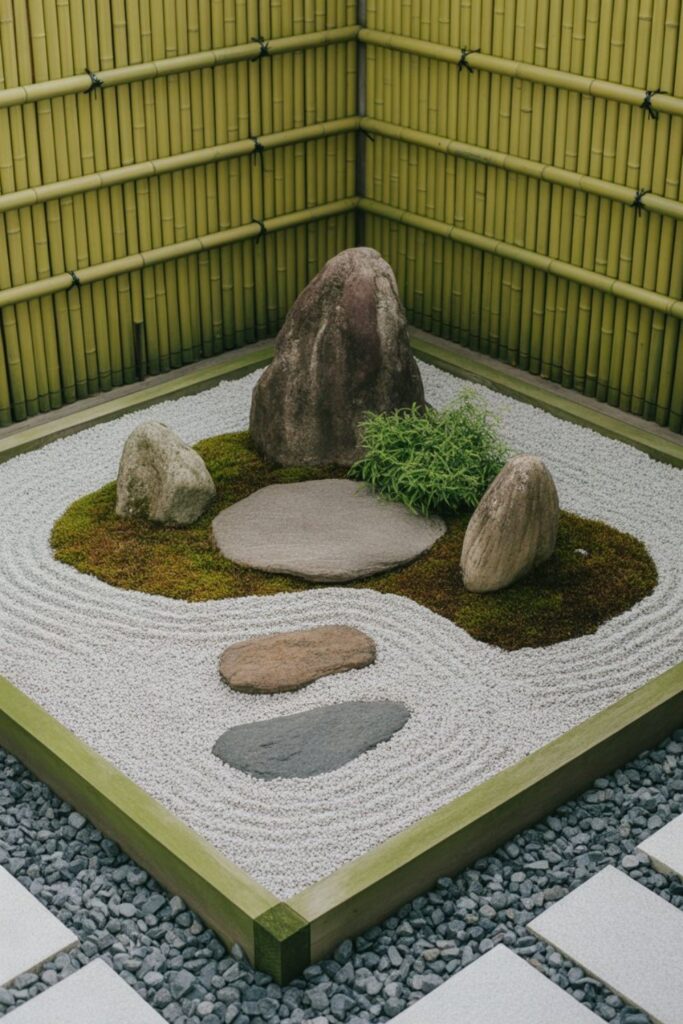
Creating affordable karesansui gardens requires resourcefulness rather than large budgets. These strategies deliver authentic results without excessive spending.
Free rock sourcing eliminates major expenses. Visit construction sites (with permission) where excavation exposes interesting stones. Many contractors happily give away rocks rather than hauling them to landfills. Natural areas after storms yield weathered rocks always check local regulations about collecting. Landscape supply companies sometimes have “reject” piles with perfectly usable stones sold at discounts. Farm supply stores sell bulk fieldstone inexpensively. Expect to spend $0-50 for sufficient rocks in small gardens through creative sourcing.
Gravel alternatives reduce material costs. Decomposed granite costs $30-40 per cubic yard versus $60-80 for specialty gravel. Crushed limestone in light colors provides a similar appearance at lower cost. Calculating carefully a 10×10 foot area at 3 inches deep needs 1 cubic yard. Buy bulk from landscape suppliers rather than bagged material at retail (saves 60-70%). DIY installation eliminates labor costs of $2,000-4,000 for professional installation. Most people complete 100-square-foot gardens in one weekend.
Simplified designs honor minimalist principles while reducing complexity. Start with three rocks and simple parallel raking patterns rather than elaborate curved designs requiring skill. Add elements gradually to a stone lantern one year, moss plantings the next. Repurposed materials create enclosures inexpensively. Use reclaimed lumber for frames, split bamboo fencing from online suppliers ($40-60 for 6-foot sections), or existing walls and fences as boundaries. Homemade rakes cost $5-10 in materials versus $40-80 for imported Japanese versions. Secure nails or screws through a board at 2-inch intervals, creating functional rakes that work perfectly. These budget rock garden strategies prove that authentic karesansui depends more on understanding design principles than expensive materials or professional help.
Common Mistakes in Japanese Rock Garden Design
Avoiding these frequent errors ensures your rock garden achieves authentic aesthetics rather than disappointing through preventable problems.
Too many rocks violates minimalist principles. Western gardeners often add excessive stones, creating busy compositions that prevent contemplation. Remember that Ryoan-ji, the world’s most famous rock garden, contains just 15 stones in 2,700 square feet. Most small gardens need only 3-7 rocks total. Even-numbered groupings feel static and artificial. Always use odd numbers 3, 5, 7, or 9 stones. Pairs lack the dynamic asymmetry that creates visual interest. Rocks sitting on surfaces rather than partially buried look artificial, as if placed yesterday rather than emerged from earth over centuries. Bury 30-50% of each rock’s mass.
Wrong gravel choices undermine authentic appearance. Beach sand or pure white decorative stone looks artificial. Choose angular pea gravel or crushed granite in natural gray, tan, or white tones. Symmetrical layouts contradict Japanese aesthetics. Avoid centering rocks, creating mirror-image arrangements, or spacing stones evenly. Colorful plants distract from stone compositions. If including plants, choose evergreens with restrained color rather than bright flowers or variegated foliage. Mixing styles combines Japanese rock gardens with incompatible elements like Chinese pagodas, Thai Buddha statues, or generic Asian decorations. Choose authentic Japanese elements exclusively.
Inadequate enclosure leaves gardens feeling exposed rather than contemplative. Install fencing, walls, or hedges that define boundaries and create sanctuary. Shallow gravel (under 2 inches) shows landscape fabric beneath and won’t hold patterns. Use 2-3 inches minimum depth. Neglecting maintenance allows weeds to invade, patterns to deteriorate, and the garden to lose its carefully crafted character. Plan for weekly raking and weeding. These rock garden mistakes prevent spaces from achieving the profound simplicity and meditative power that define authentic karesansui design.
FAQs
How much space do I need for a Japanese rock garden?
Minimum size is about 3×4 feet for a functional rock garden. Ideal small gardens range from 6×8 feet to 12×15 feet, providing enough space for proper rock arrangements and raking patterns while remaining maintainable. Even balcony containers (2×3 feet) create authentic miniature versions.
What’s the best gravel color for rock gardens?
White or light gray works best, matching traditional Japanese materials while representing water clearly. Light colors brighten spaces, show raked patterns dramatically, and create visual calm. Avoid stark white decorative stone, choose natural crushed granite or limestone in soft gray-white tones.
Do I need special tools to rake patterns?
Standard landscape rakes work adequately, though you’ll get better results from rakes with tines spaced 2-3 inches apart. Purchase Japanese rakes online ($40-80) or make your own by securing nails through boards at proper intervals ($5-10). The key is consistent tine spacing and smooth pulling motions.
How often should I re-rake the gravel?
Traditional practice involves daily raking as moving meditation. Practically, weekly raking maintains patterns in private gardens, with additional sessions after storms or heavy foot traffic disturb surfaces. The raking process itself provides meditation benefits regardless of necessity.
Can Japanese rock gardens work in hot, humid climates?
Yes, though moss cultivation becomes challenging in heat and humidity. Focus on rock arrangements and gravel patterns as primary elements, using heat-tolerant evergreens like juniper sparingly if desired. The karesansui concept works in any climate since it’s based on dry landscapes rather than lush plantings.
Conclusion
Small Japanese rock gardens prove that authentic karesansui design depends on understanding core principles rather than possessing large spaces or expensive materials. These contemplative landscapes work beautifully in areas from tiny balconies to modest backyards through the same restraint, asymmetry, and symbolism that define temple gardens. The practice of creating and maintaining rock gardens offers as much value as the finished product, selecting stones mindfully, arranging them with artistic intention, and raking patterns as moving meditation all contribute to the Zen experience these gardens promote.
Begin simply with three weathered rocks, light-colored gravel, and commitment to restraint rather than abundance. Study your rocks before placing them, considering how each suggests natural landscapes through its shape, texture, and character. Arrange them following triangular composition principles, bury them partially for natural appearance, and surround them with carefully raked gravel representing water. Resist Western impulses to add more elements, additional rocks, colorful plants, decorative objects that dilute the focused simplicity that makes karesansui powerful. Your garden will teach you through seasons and years, revealing how light changes throughout the day, how shadows shift with sun angles, and how weather patterns affect gravel surfaces.
Remember that even Zen masters consider stone arrangement a lifelong practice requiring continuous learning and refinement. Your first rock garden won’t achieve perfection, but each attempt deepens your understanding of proportion, balance, and restraint. Start this weekend by clearing a small area, laying landscape fabric, and adding gravel. Place three rocks thoughtfully, rake simple parallel lines, and sit quietly observing your creation. This humble beginning launches your journey into Japanese rock garden art, creating a personal sanctuary that provides peaceful refuge from daily chaos while connecting you with centuries-old traditions that transform simple stones and gravel into profound expressions of nature’s essential beauty.