23+ Outdoor Lighting Ideas for Stylish Spaces

You step outside after sunset and your backyard feels like a black hole. Navigation becomes guesswork, your beautiful landscaping disappears into darkness, and that expensive patio furniture might as well not exist. Poor outdoor lighting doesn’t just waste your outdoor space it creates safety hazards, reduces curb appeal, and leaves potential burglars with perfect cover.
The frustration intensifies when you realize how much money you’ve invested in your outdoor areas. That custom deck, the carefully cultivated garden beds, the outdoor kitchen you saved for years to build are all invisible once the sun sets. Meanwhile, your neighbors’ homes glow invitingly while yours fades into obscurity. You’re essentially losing half your property’s usable hours every single day.
Outdoor lighting ideas range from simple solar pathway lights to sophisticated smart lighting systems that transform your property into a nighttime masterpiece. The right combination of ambient lighting, task lighting, and accent lighting creates functional beauty that extends your living space, enhances security, and showcases your home’s architecture. This comprehensive guide explores proven exterior lighting solutions that work for every budget, style, and technical skill level, helping you reclaim your outdoor spaces after dark.
What Are the Most Effective Types of Outdoor Lighting?
Understanding the three fundamental categories of Outdoor lighting ideas helps you create layered illumination that’s both beautiful and functional. Each type serves distinct purposes, and the magic happens when you combine them strategically.
Ambient lighting provides overall illumination for outdoor areas, creating a comfortable baseline brightness level. Wall-mounted fixtures, overhead string lights, and post lamps fall into this category. These lights allow safe movement through spaces and establish the general mood. For patios and decks, aim for ambient lighting that mimics indoor living room brightness enough to see clearly but soft enough to feel relaxing. Dimmable options give you flexibility for different occasions, from quiet dinners to lively gatherings.
Task lighting focuses bright, directional light exactly where you need it for specific activities. Think about the outdoor kitchen lighting over your grill, the spotlight illuminating your door lock, or the bright fixture over your outdoor workshop area. These lights typically produce 300-700 lumens and position closely to work surfaces. Poor task lighting forces you to squint while cooking outdoors or fumble with keys at your front door problems that disappear with proper placement.
Accent lighting showcases architectural features, plants, or decorative elements while adding depth and drama to your landscape. Uplighting tall trees, washing light across textured walls, or highlighting garden sculptures creates visual interest that transforms ordinary yards into extraordinary spaces. These lights typically use lower wattage (10-50 watts for LED) and narrow beam angles (15-30 degrees) to create focused dramatic effects. When executed well, landscape accent lighting makes your property look professionally designed and adds significant perceived value.
How Do You Light a Pathway Safely and Beautifully?
Pathway lighting serves the critical dual purpose of preventing trips and falls while guiding visitors through your landscape. The proper approach balances visibility with aesthetics, creating inviting routes rather than harsh airport runways.
Space pathway lights 6-8 feet apart along both sides of walkways for optimal illumination without gaps or overly bright spots. This spacing provides overlapping pools of light that eliminate dark patches where someone might miss a step or uneven surface. For curved paths, place lights on the outside of curves where they’re most visible to approaching pedestrians. The fixture height matters tremendously; lights between 12-24 inches tall work best for standard residential paths, casting light downward onto the walking surface rather than into eyes.
Choose fixtures with downward-facing or shielded bulbs to prevent glare that temporarily blinds visitors. Bollard lights, mushroom-style fixtures, and recessed step lights all minimize upward light scatter while maximizing ground illumination. LED pathway lights consuming 3-5 watts per fixture provide ample brightness (around 100 lumens each) without excessive energy costs. Warm white color temperatures (2700-3000K) create welcoming golden tones that feel residential rather than commercial.
Solar pathway lights offer installation simplicity since they require no wiring, but research quality carefully. Premium solar models with larger panels and lithium batteries outperform cheap versions dramatically, providing 6-8 hours of consistent brightness rather than dimming after two hours. For guaranteed performance, low-voltage wired systems connected to transformers deliver consistent brightness regardless of weather conditions. A 200-watt transformer can power approximately 40 pathway lights, giving you extensive coverage from a single power source.
What Are the Best Outdoor String Light Ideas for Ambiance?
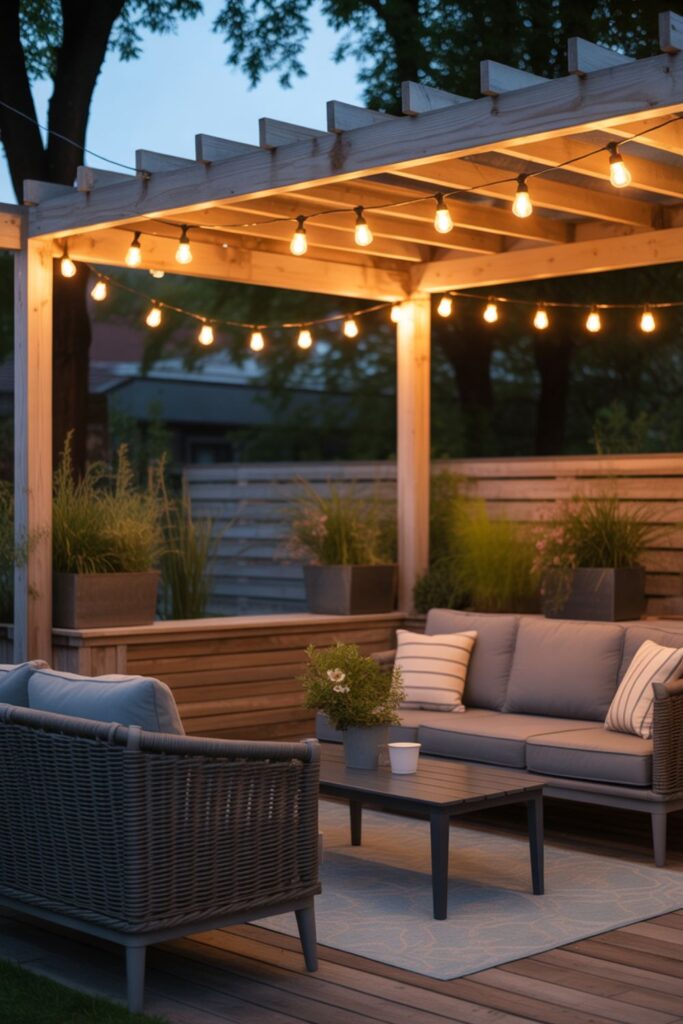
Outdoor string lights have evolved from basic party decorations into sophisticated patio lighting ideas that define outdoor rooms and create resort-like atmospheres. Strategic hanging transforms ordinary spaces into enchanting evening retreats.
Create overhead canopies by crisscrossing strings in grid patterns across patios, decks, or outdoor dining areas. This approach provides distributed ambient lighting while defining the space boundaries. Suspend strings from your house to pergola posts, between trees, or from dedicated poles installed specifically for lighting purposes. Maintain consistent height (8-10 feet) to keep lights above head level while creating an intimate ceiling effect. For larger areas, install multiple parallel runs spaced 3-4 feet apart for even coverage without dark pockets.
Edison-style bulbs with visible filaments add vintage charm and work beautifully for rustic or industrial aesthetics. Globe lights create softer, more diffused illumination perfect for contemporary or coastal designs. Cafe lights with commercial-grade construction withstand weather better than consumer versions and often include shatterproof bulbs that survive storms and accidental impacts. LED string lights consume 90% less energy than incandescent versions while lasting 25,000+ hours essentially maintenance-free for years.
Consider smart outdoor string lights that connect to Wi-Fi or Bluetooth for control via smartphone apps. These systems let you adjust brightness, change colors, set schedules, and create scenes for different occasions. Dimming capability proves essential since full-brightness string lights can feel harsh; the ability to reduce to 30-50% brightness creates perfect ambiance for intimate evenings. Weatherproof outdoor-rated strings carry IP65 ratings or higher, meaning they withstand rain, snow, and temperature extremes without deterioration.
Read More About: 20+ Plant Decor Ideas to Transform Your Space extraordinary
How Can You Use Uplighting to Enhance Landscape Features?
Uplighting creates dramatic visual effects by positioning lights at ground level and directing beams upward toward architectural or natural features. This technique adds dimension that makes landscapes look professionally designed and significantly more expensive.
Install uplights 12-24 inches from tree trunks, angling them to wash light across the bark texture and up through the canopy. This creates stunning silhouettes of branch structures against night skies while making trees appear larger and more majestic. For multi-trunk trees or shrubs, place two or three uplights at different angles to eliminate harsh shadows and create fuller illumination. Adjust beam angles seasonally as trees grow what works perfectly in spring may need readjustment once summer foliage fills in.
Wall washing involves placing uplights 2-3 feet from textured walls, stone facades, or architectural details to graze light across surfaces. This technique emphasizes texture brick, stone, stucco, or wood siding creating visual interest from flat surfaces. Narrow beam angles (15-25 degrees) work best for tall walls or specific architectural elements like columns. Wider beams (35-60 degrees) suit shorter walls or when you want even illumination across larger areas.
Use colored uplighting sparingly and intentionally. Blue lights can highlight water features or create moonlight effects. Amber or warm white tones complement earth-tone architecture and natural materials. RGB color-changing uplights offer versatility for seasonal decoration orange for fall, red and green for winter holidays, pastels for spring but ensure they also produce quality white light for everyday use. Position uplights in garden beds or behind low walls to hide fixtures while showcasing effects, maintaining focus on illuminated features rather than light sources themselves.
What Are Creative Deck and Patio Lighting Solutions?
Deck lighting and patio lighting extend your outdoor living hours while adding safety to elevated structures. Modern solutions go far beyond basic overhead fixtures, incorporating lights into architectural elements themselves.
Recessed deck lights install flush with flooring surfaces around perimeter edges, creating subtle boundary definition without protruding fixtures that catch feet. Space these lights 4-6 feet apart along railings and stairs for continuous guidance. Many modern deck lights feature interchangeable lenses that let you change colors or beam patterns without replacing entire fixtures. Solar-powered deck lights simplify installation on existing decks since you avoid running new electrical lines through finished structures.
Stair lights prevent the most common outdoor injury missing a step in darkness. Install one fixture per stair riser, either recessed into vertical faces or mounted underneath tread noses to shine downward. This creates subtle guidance without harsh brightness that interferes with conversation areas. Motion-activated stair lights save energy while ensuring illumination appears exactly when needed as someone approaches.
Railing post cap lights combine decoration with function, topping deck posts with illuminated caps that mark boundaries while adding architectural interest. Choose styles matching your railing system copper caps for traditional designs, stainless steel for contemporary, solar options for retrofit situations. Post lights also make excellent landmarks when returning home after dark, helping you visually locate deck access points from your driveway.
Under-rail lighting strips attach beneath handrails, washing light downward across balusters and decking. This creates dramatic effects similar to architectural lighting in upscale venues. LED strips offer color-changing capabilities and dim easily via controllers or smartphone apps. The indirect nature means comfortable brightness for conversation areas while maintaining clear visibility of walking surfaces. Combine under-rail strips with recessed floor lights for comprehensive deck lighting ideas that work from multiple angles.
How Do You Illuminate Outdoor Living Spaces Like Kitchens?
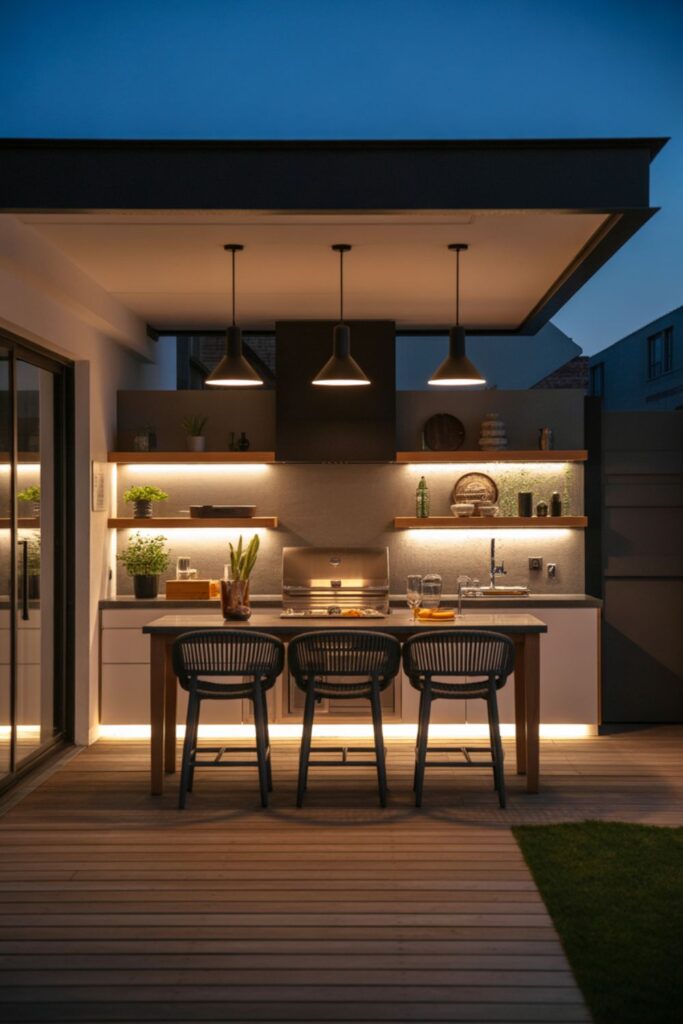
Outdoor kitchen lighting requires the same careful planning as indoor kitchens since you need bright task lighting for food preparation while maintaining pleasant ambient light for dining and entertaining. Multi-layer approaches work best.
Install focused task lights directly above grills, prep counters, and sink areas where detailed work happens. Overhead fixtures producing 500-700 lumens per square foot provide restaurant-quality visibility for cooking after dark. Adjustable fixtures let you direct light exactly where needed as you move between stations. Weatherproof downlights with sealed housings protect against grease splatter and moisture look for fixtures rated for wet locations rather than just damp areas.
Under-cabinet lighting in outdoor kitchens illuminates countertops beautifully while hiding fixtures from direct view. LED strips or puck lights mount underneath upper cabinets or shelving, creating functional task light without cluttering sight lines. This approach works especially well in covered outdoor kitchens where overhead structures provide mounting surfaces. Warm white (2700-3000K) color temperatures make food look appetizing while creating a welcoming atmosphere.
Add ambient perimeter lighting around outdoor living rooms, dining areas, and bars to define spaces and reduce contrast between bright task areas and dark surroundings. Wall sconces, suspended pendants, or even candle-style fixtures on nearby walls provide this background illumination. Dimmer controls prove essential since ideal brightness varies dramatically between cooking (when you want maximum visibility) and dining (when softer light feels more appropriate). Smart lighting systems let you save preset scenes “Prep Mode,” “Cooking Mode,” “Dining Mode,” “Party Mode” that adjust multiple fixtures simultaneously with single commands.
What Are Energy-Efficient Outdoor Lighting Options?
Energy-efficient outdoor lighting has become both economically smart and environmentally responsible as LED technology has matured. Modern options provide superior light quality while consuming a fraction of the electricity.
LED fixtures use 75-90% less energy than traditional incandescent bulbs while lasting 25,000-50,000 hours compared to 1,000-2,000 hours for old-style bulbs. This longevity means you replace bulbs once every 10-20 years rather than annually, dramatically reducing maintenance hassles and costs. Initial LED fixture prices have dropped significantly, what cost $50-100 five years ago now costs $15-30 for comparable quality. Calculate total cost of ownership over 10 years and LEDs win overwhelmingly despite slightly higher purchase prices.
Solar outdoor lighting harnesses free energy from the sun, eliminating electrical costs entirely. Modern solar technology has improved dramatically with better photovoltaic panels, lithium batteries, and efficient LEDs working together. Premium solar lights now provide 8-10 hours of consistent brightness after charging during daylight hours. Place solar fixtures where they receive 6+ hours of direct sunlight daily shaded locations produce disappointing results regardless of light quality. Clean solar panels monthly to maintain charging efficiency, as dust and debris reduce power collection by 20-40%.
Motion sensors reduce energy consumption by activating lights only when needed rather than burning continuously. Strategic motion-sensing works perfectly for security lights, driveway lighting, or rarely-used side yards. Adjust sensitivity settings to avoid triggering from small animals or blowing branches while reliably detecting humans. Some motion systems offer dual-mode operation dim ambient light continuously with bright activation upon motion detection providing constant low-level security while conserving energy.
Photocells and timers automate outdoor lighting without requiring manual switching. Photocells turn lights on automatically at dusk and off at dawn, adjusting naturally with seasonal changes. Programmable timers offer more control, letting you specify exact on/off times or different schedules for different days. Astronomical timers calculate sunrise and sunset times based on your GPS coordinates, automatically adjusting throughout the year for perfect automation. Combining these technologies with efficient LED fixtures can reduce outdoor lighting energy costs by 85-95% compared to traditional systems.
How Can You Create Dramatic Water Feature Lighting?
Water feature lighting adds enchanting visual interest to fountains, ponds, waterfalls, and pools while extending enjoyment into evening hours. Proper lighting transforms water from daytime focal point into nighttime showpiece.
Submersible LED lights installed beneath water surfaces create magical glowing effects as light refracts through moving water. Position lights behind or beneath waterfall flows to make cascading water appear to glow from within. For ponds, place submersible lights near the bottom at various depths and angles to create dimensional lighting that reveals fish, plants, and water depth. Color-changing RGB submersible lights add versatility blue for tranquil evenings, green for garden party themes, or rotating colors for celebrations.
Fountain lighting works best when positioned to highlight water streams without visible fixtures competing for attention. Hide light sources behind fountain structures, inside basins, or beneath water-spouting elements. Uplighting fountain sculptures from below creates dramatic silhouettes against night skies. For tiered fountains, light each level separately with independently controlled fixtures so you can adjust the look for different occasions or simply turn off upper tiers to reduce brightness while maintaining presence.
Pool lighting has evolved beyond simple underwater bulbs to include perimeter lighting, deck lighting, and water-effect lights. Modern fiber optic and LED pool lights mount flush with pool surfaces, eliminating the sharp edges and heat issues of older halogen systems. Perimeter lights around pool edges enhance safety by clearly defining boundaries and preventing accidental falls. Underwater lights shine upward through water, creating the classic glowing pool effect while making nighttime swimming safer and more enjoyable.
Avoid overlighting water features and excessive brightness destroys the magical quality that makes them special. Subtle illumination that enhances without overwhelming works best. Start with lower wattage fixtures (5-15 watts for LEDs) and add more only if needed. Water naturally amplifies light through reflection and refraction, so less fixture power produces more visible effect than you’d expect.
What Are the Best Security Lighting Strategies?
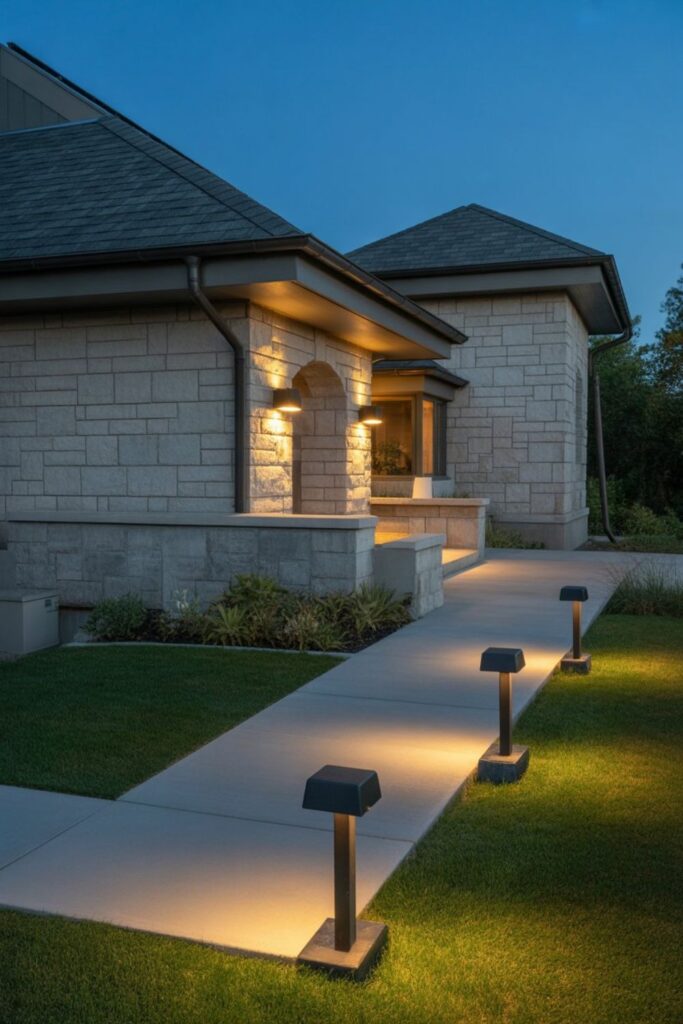
Outdoor security lighting deters intruders while making your property safer for family and visitors. Effective security lighting balances brightness, coverage, and energy efficiency without creating light pollution or annoying neighbors.
Motion-activated floodlights provide the most dramatic security response sudden bright illumination startles potential intruders and alerts occupants to movement. Install motion lights covering all entry points including front doors, back doors, garage doors, and ground-floor windows. Adjust detection zones carefully to cover approach paths without triggering from street traffic or neighboring properties. Modern motion lights offer adjustable sensitivity, timer duration (30 seconds to 10 minutes), and detection range (20-70 feet) for customized performance.
Dusk-to-dawn security lights maintain constant illumination throughout night hours, eliminating shadows where intruders could hide. These work especially well for driveways, side yards, and any dark areas around your property perimeter. Photocell-activated lights turn on automatically at sunset and off at sunrise without requiring programming or manual operation. LED versions make continuous operation affordable; a 20-watt LED security light costs roughly $2-3 monthly to operate compared to $8-12 for equivalent halogen fixtures.
Layer security lighting at different heights for comprehensive coverage. Ground-level path lights illuminate potential tripping hazards while marking property boundaries. Mid-level wall lights (7-10 feet high) provide facial recognition capability essential for security cameras and identifying visitors. High-mounted floodlights cover wide areas and eliminate overhead hiding spots. This three-tier approach creates overlapping illumination zones that eliminate shadows where intruders prefer to move.
Smart security lights integrate with home automation systems, security cameras, and smartphone apps for advanced control. Receive alerts when motion triggers lights, view live camera feeds, control lights remotely, or create lighting schedules that simulate occupancy while traveling. Some systems use artificial intelligence to distinguish between people, vehicles, and animals, reducing false alarms while maintaining security responsiveness. Integration with voice assistants lets you control security lighting with simple commands “Alexa, turn on driveway lights” or “Hey Google, activate security mode.”
How Do You Light Trees and Garden Beds Effectively?
Garden lighting and tree lighting transform landscaping investments into 24-hour assets while adding depth and dimension to outdoor spaces. Professional techniques create magazine-worthy results on residential budgets.
Tree uplighting requires positioning fixtures 1-2 feet from trunks at ground level, angling light upward at 30-45 degrees. This grazes texture across bark while illuminating branch structures and foliage. For narrow trees, single uplights work fine. Wider specimens need 2-3 lights positioned around the trunk to eliminate harsh shadows and create balanced illumination. Narrow beam angles (10-25 degrees) work best for tall trees, concentrating light upward where you want emphasis rather than spilling across lawns.
Downlighting from tree branches creates natural moonlight effects that feel organic rather than artificial. Install fixtures high in trees (15-25 feet) pointing downward and outward to cast gentle dappled light across lawns, patios, or seating areas below. This technique requires climbing or professional installation but creates effects impossible to replicate with ground-based lights. Use fixtures specifically rated for tree mounting with adjustable brackets that avoid damaging bark as trees grow.
Garden bed lighting showcases flowers, ornamental grasses, and low shrubs beautifully when approached correctly. Cross-lighting (illuminating from multiple angles) creates depth and prevents flat appearances. Place small spotlight-style fixtures 3-5 feet away from featured plants, adjusting angles to highlight blooms or interesting foliage. For layered gardens, light specimens at different depths to create dimensional effects front plants lit from behind, middle layer from sides, back specimens from front.
Seasonal adjustment maintains optimal appearance as plants grow and change. Spring bulbs need different lighting positions than summer perennials or fall chrysanthemums. Deciduous trees that look perfect when uplighted in summer may need additional fixtures in winter when bare branches create different silhouettes. Mark fixture locations and preferred angles so you can return to successful configurations each season. Quality landscape lighting systems use bullet-style adjustable fixtures that let you redirect beams without tools as plantings evolve.
What Are Smart Outdoor Lighting Options and Benefits?
Smart outdoor lighting systems provide unprecedented control, automation, and customization through connectivity with smartphones, voice assistants, and home automation platforms. Modern technology makes complex lighting scenarios accessible to average homeowners.
Wi-Fi and Bluetooth-enabled fixtures connect directly to your home network, allowing control via manufacturer apps without requiring additional hubs or controllers. Adjust brightness, change colors, create schedules, and group fixtures by zones (front yard, backyard, driveway) for unified control. Most systems integrate with Amazon Alexa, Google Assistant, or Apple HomeKit for voice commands “turn on patio lights to 50%” or “set backyard to party mode” controls multiple fixtures simultaneously.
Programmable scenes let you save preferred settings for different occasions rather than manually adjusting multiple fixtures each time. Create “Dinner Party” scenes with bright task lighting over cooking areas and soft ambient light elsewhere, “Movie Night” with minimized light pollution around outdoor viewing areas, or “Security Mode” with strategic high-intensity zones. Switching between scenes takes seconds rather than walking around adjusting individual dimmers.
Scheduling automation means lights activate and deactivate without human intervention, providing security benefits when traveling and convenience in daily life. Smart systems calculate sunset and sunrise times based on your location, automatically adjusting throughout the year rather than requiring seasonal reprogramming. Create vacation modes that randomly vary lighting times to simulate occupancy. Schedule landscape lighting to operate from dusk until midnight rather than all night, reducing energy costs without sacrificing evening enjoyment.
Integration with security cameras, motion sensors, and door locks creates comprehensive smart home systems where outdoor lighting responds to multiple triggers. Motion at your front door can activate pathway lights, porch lights, and cameras simultaneously. Unlocking doors can trigger welcome lighting. Geofencing activates lights automatically as you approach home. These interconnected behaviors create seamless experiences that feel effortless while providing functionality impossible with traditional switches.
How Do You Choose the Right Color Temperature for Outdoor Lighting?
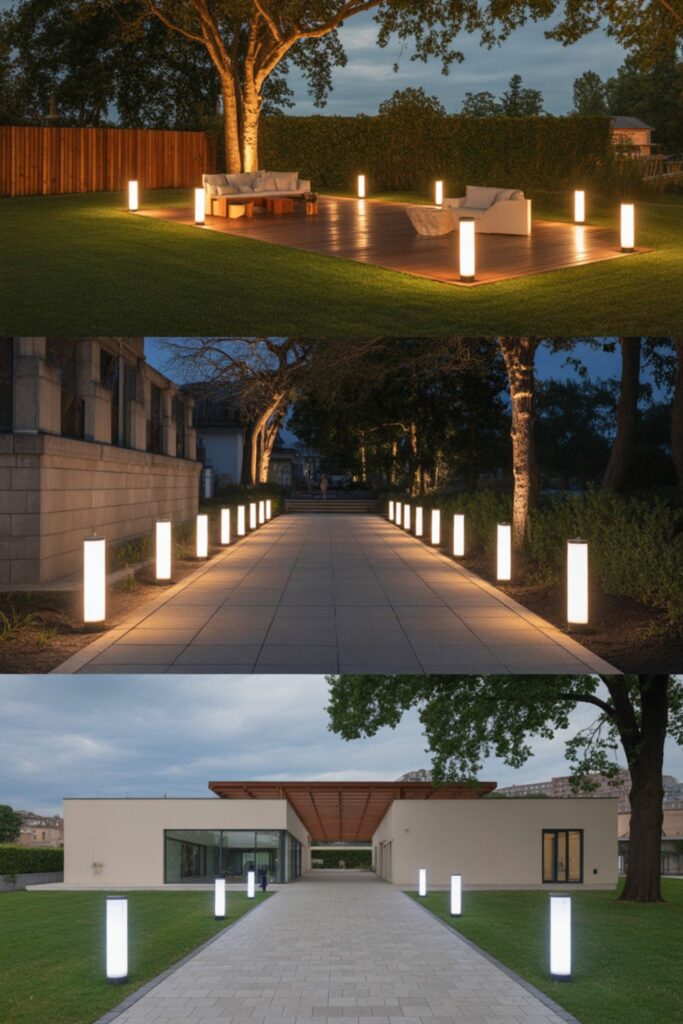
Color temperature dramatically affects outdoor ambiance, with choices ranging from warm candlelight tones to cool moonlight effects. Understanding the Kelvin scale helps you select temperatures that complement your home’s architecture and create intended moods.
Warm white (2700-3000K) produces golden, amber-toned light similar to traditional incandescent bulbs. This range works beautifully for residential settings, creating welcoming, cozy atmospheres perfect for entertaining and relaxation. Warm tones complement earth-tone materials like brick, stone, wood, and bronze fixtures while making skin tones appear healthy and food look appetizing. Most outdoor living space lighting benefits from warm white temperatures that mirror indoor lighting for visual continuity.
Neutral white (3500-4100K) falls between warm and cool, producing cleaner light with less yellow or blue cast. This temperature works well for task lighting in outdoor kitchens, workshops, or activity areas where color accuracy matters. Neutral white also suits contemporary or minimalist designs where warm tones might feel too traditional. The balanced spectrum provides excellent visibility without the stark coldness of higher temperatures.
Cool white (5000-6500K) creates bright, bluish light similar to daylight or moonlight. This temperature works selectively in outdoor spaces, excellent for security lighting where maximum visibility trumps ambiance, or for creating moonlight effects in landscape lighting. Cool white enhances blue and green plants beautifully but can make warm-toned materials look washed out or institutional. Commercial properties often use cool white for parking areas and building exteriors, but residential applications require more caution.
Consistency matters more than specific temperature choices mixing drastically different temperatures creates jarring, unprofessional results. Stick within 500-700K range across adjacent fixtures for visual harmony. When layering lighting types (ambient, task, accent), keeping all fixtures at similar temperatures creates cohesion even when brightness levels vary. The exception involves intentional contrast effects like cool-toned moonlighting through trees over warm-lit patios, but these scenarios require careful design to avoid clashing.
What Are Common Outdoor Lighting Mistakes to Avoid?
Understanding frequent outdoor lighting errors helps you avoid expensive mistakes that undermine both aesthetics and functionality. These problems appear in countless residential installations despite being easily preventable.
Overlighting ranks as the most common error installing too many fixtures, excessive wattage, or overly bright bulbs that destroy nighttime ambiance while wasting energy. More fixtures rarely equals better results. Strategic placement of properly powered lights outperforms scattered excessive lighting every time. Start with fewer fixtures than you think necessary and add more only if genuine gaps exist. Remember that eyes adapt to darkness what seems too dim initially often provides perfect illumination after adjustment.
Fixture visibility undermines professional appearances when light sources draw attention from illuminated features. Quality landscape lighting emphasizes effects while hiding fixtures through strategic placement in garden beds, behind walls, or beneath architectural elements. Exposed fixtures on stakes scattered across lawns announce amateur installation. Invest time positioning fixtures where they’re effective but discreet, using vegetation and structures for concealment.
Ignoring beam angles creates either weak ineffective lighting or harsh spotlight effects. Wide flood beams (60-120 degrees) work for washing large surfaces but waste light when trying to highlight specific features. Narrow spot beams (10-30 degrees) excel at accenting vertical elements but leave dark gaps when used for path lighting. Match beam angles to applications spots for uplighting trees and architectural details, floods for wall washing and ambient coverage, medium beams (35-50 degrees) for pathways and general purposes.
Poor wire management in low-voltage systems causes voltage drop that leaves distant fixtures dim while near ones shine brightly. Run adequate wire gauge for circuit length 14-gauge wire for runs under 100 feet, 12-gauge for 100-150 feet, 10-gauge beyond 150 feet. Use hub systems that distribute power from central points rather than daisy-chaining fixtures across long distances. Place transformers centrally to minimize maximum run lengths, and split large systems across multiple transformers rather than overloading single units.
Neglecting maintenance allows deterioration that reduces performance and lifespan. Clean fixtures annually to remove spider webs, dirt, and oxidation that block light output. Trim vegetation that has grown to obstruct fixtures or create unintended shadows. Check and tighten wire connections that loosen from thermal cycling and ground movement. Replace yellowed or cloudy lenses that reduce light transmission. Adjust fixture aims as trees grow and landscaping matures. These simple tasks maintain optimal performance for decades.
Read More About: 17+ Outdoor Kitchen Patio Ideas for miraculous Alfresco Dining
How Can You Create Outdoor Lighting on a Budget?
Budget outdoor lighting doesn’t require sacrificing quality or effectiveness when you prioritize wisely and leverage cost-effective technologies. Strategic approaches create impressive results without premium price tags.
Solar lighting eliminates electrical costs entirely no electrician fees, no trenching, no wire, no transformer, no ongoing electricity expenses. Quality solar fixtures now rival hardwired performance for many applications. Focus solar lights in high-sun areas where charging succeeds reliably. Use solar for pathways, accent lighting, and decorative purposes while reserving hardwired systems for critical task lighting that demands consistent performance. Mixing both technologies optimizes cost-effectiveness while maintaining reliability where it matters most.
Low-voltage systems cost significantly less than line-voltage installations while providing comparable lighting quality. DIY-friendly low-voltage kits include everything needed transformer, wire, fixtures, stakes, connectors often for under $200-300 for complete systems. Installation requires no electrical expertise beyond connecting wires to a transformer that plugs into standard outlets. Low-voltage fixtures cost $15-40 each compared to $50-150 for line-voltage equivalents, allowing broader coverage within fixed budgets.
Phased installation spreads costs across multiple years while building comprehensive lighting systems gradually. Start with highest-priority areas entry lighting for safety, pathway lighting for navigation, or patio lighting for frequent entertaining spaces. Add accent lighting, landscape features, and refinements in subsequent seasons as budget allows. This approach also lets you learn your property’s lighting needs through experience rather than trying to perfect everything immediately. Many homeowners discover that their phase-one installations actually satisfy most needs, with subsequent additions being enhancements rather than necessities.
String lights provide maximum ambiance per dollar, with weatherproof LED cafe lights costing $30-60 for 25-50 foot strands. A few strategically hung strands create inviting atmosphere across patios, decks, or outdoor dining areas for under $200 total investment. Commercial-grade string lights last 3-5 seasons even with continuous outdoor exposure, making annual cost under $50. Compared to permanent overhead fixtures costing $200-500 each, string lights deliver incredible value for ambient lighting applications.
DIY installation saves 50-75% compared to professional installations while providing valuable learning about your lighting system. Low-voltage systems present minimal electrical challenges suitable for beginners. Watch manufacturer tutorials, follow provided instructions carefully, and test circuits before burying wires permanently. Reserve professional services for line-voltage connections requiring permits and licensed electricians, but handle low-voltage fixture placement, aiming, and adjustment yourself. Most homeowners successfully install comprehensive systems over single weekends using basic tools and patience.
Frequently Asked Questions
What is the best wattage for outdoor lights?
LED outdoor lights typically need 5-15 watts for accent and path lighting, 15-25 watts for area lighting, and 25-50 watts for security and flood lighting. These LED wattages produce equivalent brightness to old incandescent bulbs consuming 3-5 times more power. Focus on lumens rather than watts pathway lights need 100-200 lumens, accent lights 200-400 lumens, security lights 700-1300 lumens.
How many outdoor lights do I need?
Calculate outdoor lighting needs based on coverage area and purpose rather than arbitrary numbers. Pathway lights space 6-8 feet apart along both sides. Accent lights position 1-3 per feature depending on size. Security lights cover entry points with one fixture per door and 1-2 per side of the house.
Should outdoor lights be warm or cool white?
Warm white (2700-3000K) works best for residential outdoor lighting, creating inviting ambiance that complements architectural materials and makes spaces feel welcoming. Reserve cool white (5000-6500K) for security applications requiring maximum visibility or moonlight effects in landscape designs.
How long do outdoor LED lights last?
Quality outdoor LED lights last 25,000-50,000 hours, translating to 15-30 years when operated 4-5 hours nightly. This longevity eliminates frequent bulb changes while reducing long-term costs despite higher initial prices. Cheaper LED products may only last 10,000-15,000 hours due to inferior components and heat management.
What is the difference between landscape lighting and security lighting?
Landscape lighting emphasizes aesthetics, highlighting architectural and natural features while creating ambiance through layered accent, ambient, and task lighting. These fixtures typically operate at lower brightness (50-400 lumens) with careful positioning to hide sources while showcasing effects. Security lighting prioritizes visibility and deterrence, using brighter fixtures (700-1300 lumens) in obvious positions covering entry points and vulnerable areas.
Can I install outdoor lighting myself?
Low-voltage outdoor lighting (12-volt systems) offers straightforward DIY installation requiring no electrical licensing: connect transformer to outlet, run wire, position fixtures, make connections. These systems carry minimal shock risk and don’t require permits in most jurisdictions. Line-voltage installations (120-volt) connecting directly to household electrical panels require licensed electricians and permits in most areas due to safety concerns and code requirements.
Conclusion
The right outdoor lighting ideas extend your property’s functional hours while dramatically enhancing curb appeal, security, and property value. Combining ambient lighting for overall illumination, task lighting for specific activities, and accent lighting for dramatic effects creates layered sophistication that transforms ordinary yards into extraordinary outdoor living spaces. Whether you’re illuminating pathways for safety, uplighting trees for visual impact, or creating inviting patio environments with string lights, thoughtful lighting design makes every outdoor moment more enjoyable.
Start with clear priorities based on how you actually use outdoor spaces, then build comprehensive systems gradually using energy-efficient LED and solar technologies that minimize operating costs. Focus on hiding fixtures while showcasing effects, maintain consistent color temperatures for professional results, and avoid over lighting that destroys nighttime ambiance. Quality outdoor lighting doesn’t require massive budgets when you leverage cost-effective solutions like low-voltage systems, DIY installation, and smart controls that maximize flexibility. Your outdoor spaces deserve the same lighting consideration as interior rooms proper illumination makes them equally livable while creating lasting impressions that elevate your entire property.